
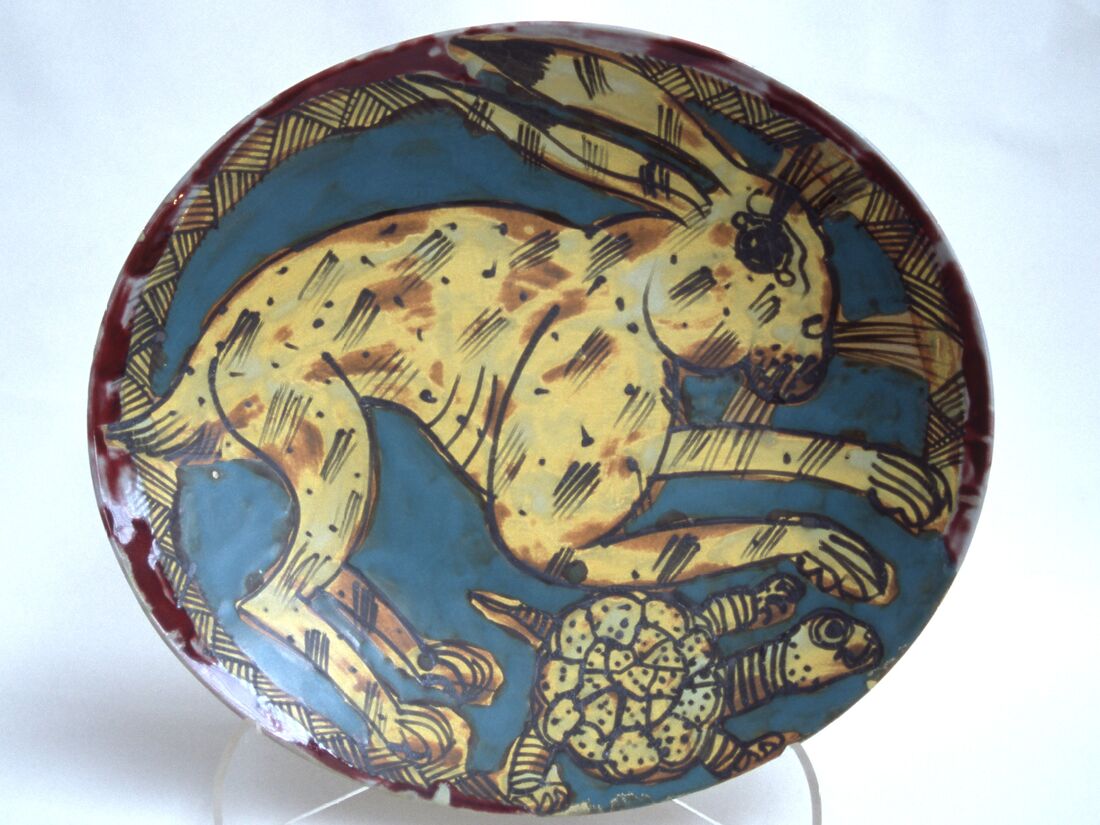

Stoneware in fine form
By JEFF SHAW. The Courier Mail Friday September 25, 1998
TWO years ago. John Weavers Cintra Galleries opened the exhibition Majolica Ceramics by Alexandra Copeland. It proved to be one of Brisbane's finest exhibitions of the year.
Painterly and decorative in a bright Italianate way, Copeland's pots seemed eminently collectable and handsomely usable. Her jugs, bowls and platters in that exhibition exemplified the majolica tradition, while her riotous images and wide ranging allusions and borrowings are memorable.
The strength of her work has been such as to classify Copeland as a majolica artist.
This latest exhibition, therefore, arrives as an absolute but agreeable surprise. Copeland. who adopted majolica ware as a colourful reaction against the popular but more conservative Japanese glazes, has now turned for inspiration to work in the Dartington Pottery founded by Bernard Leach, the greatest European exponent of Japanese ceramics.
Leach, it may be remembered. was also greatly impressed by English slipware and his own style became a fusion of Eastern and Western traditions.
Now it seems Copeland has managed to absorb the Leach background to produce another remarkable range of work for her repertoire, after two invited residencies in the busy Dartington Pottery founded by Leach.
The first hint of this shift of direction came with the illustrated invitation depicting a Copeland Hare Jug with an image strongly reminiscent of the frequently printed Large Raku Platter (with hare image) by Bernard Leach in 1918.
Copeland does admit that the hare image could be seen as a tribute to Leach. 'But there are still lots of hares around the place and they are a pleasure to draw and if you recall, hares were popular with both Chinese and 16th-century Spanish artists," she said.
The hare provides only a small part of the bestiary of images which Alexandra Copeland has in the range of pots ready for display. The overall impression obtained is one of unusual richness and variety in the stoneware range.
Those qualities are to be found in images and colours as well as in the vessel forms. A large oval platter, Rainbow Trout, depicts two brilliant mottled fish on a red foil within a basket pattern surround.
This is one of many delightful pieces reflecting elements of English slipware tradition and theme. Other themes and motifs are seen in Frog Pond bowls. Grasshopper platters alongside Crabs, Insects, Fox and Hare, Owl and Rat, Punch and Judy, Nasturtiums and others.
The images and forms present constant references to traditions which have helped shape Australian pottery.
The small Night and Day plate has an endearing image of a thrush on a bright lawn contrasting with a dark night sky. Frog Pond bowl would be another breakfast delight.
These are relatively simple subjects depicted with vigour and individuality while displaying much of the charm of older decorated ware. Also appealing are the tall beer or cider jugs with strap handles and mediaeval form.
The strength of these works must be seen as a composite of favourite traditional images, of forms and allusions revitalized by Copeland's artistry and skills.
The very reason for her invitation to Dartington is the basis for the continuing appeal of the Copeland work. That is, the individual quality of her freehand drawing informs every item, giving vigour and appeal to the forms.
Behind the individual on this occasion has been the added strength of the Dartington kilns and research to add to the artist's personal experimentation with a wide range of stoneware glazes and colours.
The result has provided us with a wonderful display of ceramics destined to become everyday delights and treasures for families and collectors.
· Reduction-fired stoneware, by Alexandra Copeland. Cintra Galleries, 40 Park Rd, Milton. until October/
[DECORATIVE and usable . . . Alexandra Copeland's Hare Jug.]
Italian Journey
Alexandra Copeland, at Solander Gallery, 36 Grey Street, Deakin, until December 18. The Canberra Times Wed 14 Dec 1994. By Meredith Hinchliffe
IN 1992 Alexandra Copeland received a grant from the Australian Council enabling her to travel to Italy and work in the pottery studios in the village of Deruta. The studios of Deruta have produced majolica ware ceramics since the 13th century.
Maiolica (as it was originally) is a technique developed in the Middle East in about the 10th century in an attempt to compete with the blue-and-white porcelain of China. Knowledge of the techniques moved to Spain and Italy and to England and it evolved along the way. Designs were generally copied — especially from early wood cuts. Today, in Deruta the designs are mainly derived from museum collections or reference books.
In Australia, there is no ongoing tradition of Maiolica and Copeland had to develop her own techniques and methods to overcome technical problems. She found many of these had been solved centuries ago in Deruta. While there, she continued to work in her own style, resisting to conform to the production methods used in the workshops.
The exhibits are traditional medieval forms – generous platters, jugs and bowls used in banquets. They are ideal for serving food in contemporary Australian life – informal, lively and generous.
There are large, full-bellied jugs decorated with arum lilies. The stems wind around the body and become handles, while the flower forms the lips and spout. Large platters with wide rims and bowls are highly decorated with lilies, stars, cats, fish and mythical animals and birds.
This artist has developed glaze colours which are clear and bright and are set off by the thick, white ground. The entire internal surface of each of the works is carefully and intricately embellished and the backs or reverse of the bowls and platters are also decorated. Several carry an element from the main canvas and repeat it, while others have the spontaneous splashes reminiscent of medieval times.
The works are exuberant, almost voluptuous. Grasshoppers play among violets, cicadas mix with passion flowers, dragonflies are having sex on a bed of brilliant bougainvillea flowers. All motifs are drawn from life and have a timeless quality.
Copeland has drawn from those civilisations which developed Maiolica — Islamic, Spanish and Italian, and the blue-and-white porcelain of China and Dutch Delft to develop her own techniques and decorative images. The Maiolica technique allows her the freedom to paint on clay.
These works are intended to be used and handed down from generation to generation so they have as much relevance in 200 years as they have today.